
North Houston commute routes and what they do to your paint
If you drive any significant stretch of I-45 North, Highway 249, or the Grand Parkway between Tomball and downtown Houston on a regular basis, your vehicle is absorbing damage that most owners do not notice until it has accumulated into something that requires serious correction. The North Houston highway network moves a high volume of commercial traffic alongside daily commuters, and that mix produces specific, predictable paint hazards that are worth understanding before they reach the point of a repaint.
This is not about a single rock chip or a bad day on the road. It is about the cumulative effect of doing the same route five days a week for months or years. The cars that come into EuroLuxe showing the worst paint condition are rarely ones that had a single incident. They are daily drivers that were left unprotected on routes that simply do not forgive bare paint.
I-45 North: the chip corridor
I-45 between downtown Houston and The Woodlands is one of the highest-traffic freight corridors in the region. The road surface stays in a state of ongoing construction and repair for long stretches, which means exposed aggregate, loose material, and trucks hauling gravel, concrete, and demolition debris at freeway speeds. Following distance helps but does not eliminate the problem at 70 miles per hour.
The front end of any vehicle that commutes this corridor regularly is the first thing to show the accumulation. Hood leading edge, front bumper, lower fenders, and the front corners of the roof all collect chips and micro-abrasions. On a dark-colored vehicle the damage becomes visible to the naked eye within a year of unprotected driving. On lighter colors it often hides until the clear coat begins to fail in isolated spots.
Drivers coming down from Conroe, Willis, and Spring who are on I-45 for forty minutes or more each direction are among the highest-risk commuters for this type of wear.
Highway 249 and the construction factor
The 249 tollway extension through Tomball, Pinehurst, and toward Magnolia has been under active development for several years. Active construction zones mean loose material on the pavement, uneven transitions between old and new surface, and truck traffic accessing job sites at multiple points along the corridor.
Beyond the construction zones, 249 passes through areas with significant tree canopy, particularly between Tomball and Pinehurst. That means organic fallout: tree sap, pollen accumulation in wet seasons, and bird activity over parked vehicles at the various park-and-ride and commercial stops along the route. These contaminants sit on paint in Texas heat and etch into clear coat within hours during the summer months.
The lower panels on vehicles that park under trees regularly show iron contamination and chemical etching that requires paint correction before any protective coating will bond properly. It is one of the more common issues we see from 249 corridor drivers.
The Grand Parkway and suburban expansion zones
SH 99 through Cypress, Spring, and out toward Katy is a different kind of risk. The road surface itself is newer and generally in better condition than I-45, but the surrounding development is relentless. Freshly graded earth adjacent to the roadway, concrete mixer trucks, and dump trucks entering and exiting construction sites along the entire corridor create airborne particulate that lands on paint during every drive.
Cement dust is particularly damaging because it is alkaline and reacts with clear coat when activated by moisture. A vehicle that sits outside overnight with cement dust on the surface and then gets rained on will often show chemical spotting that does not wash off. The Grand Parkway’s expansion into areas like Bridgeland, Towne Lake, and the Tomball Parkway corridor means this is an ongoing issue rather than a temporary construction phase.
Drivers making the cross-town run on 99 between Katy and The Woodlands are covering some of the highest-density construction frontage in Harris County on any given weekday.
What protection actually makes sense for a commuter
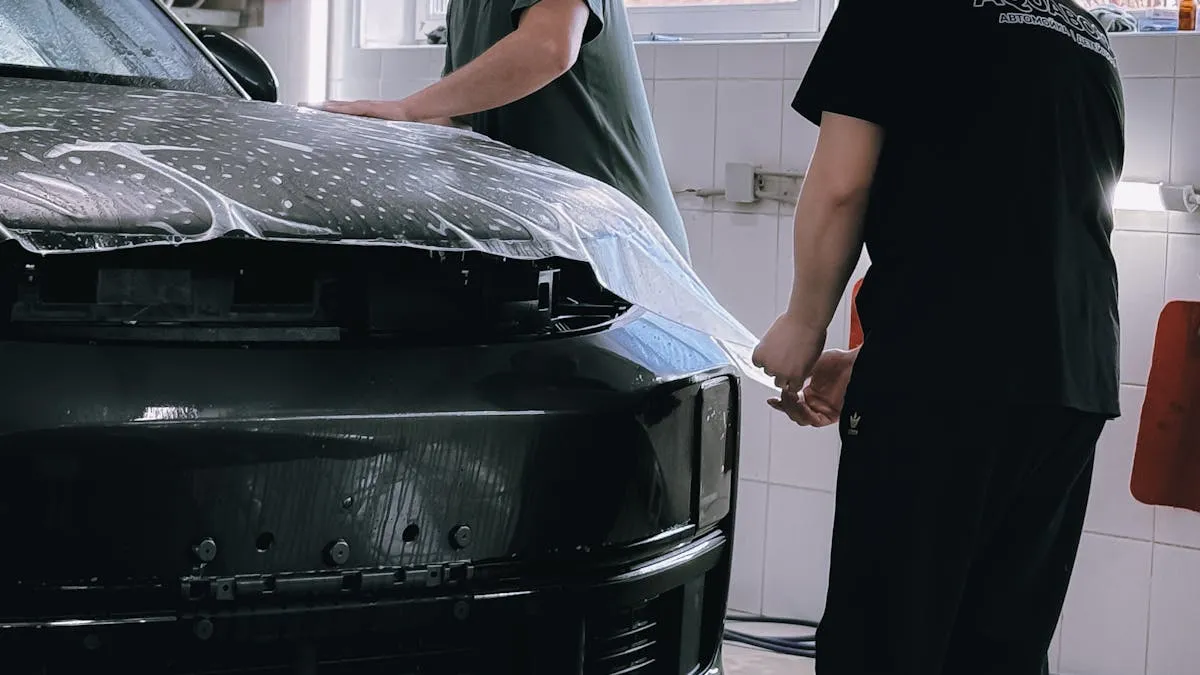
The answer depends on how much of the vehicle is exposed and what the budget allows. A full-body paint protection film installation is the most complete answer, but even a partial front package covering the hood, fenders, front bumper, mirrors, and A-pillars addresses the zones that absorb the vast majority of impact damage on a highway commuter.
For vehicles that do not need film across the entire body, stacking a quality ceramic coating over the painted surfaces that are not covered by film gives the clear coat a sacrificial layer that is far more resistant to chemical etching, industrial fallout, and the abrasive contact that comes from automatic car wash use between professional washes. The combination is not redundant. Film handles physical impact. Ceramic handles chemical and UV exposure. Together they cover nearly every failure mode a North Houston commuter encounters.
The UltraFit film we use is cut and installed on-site in a climate-controlled bay, which matters more than it sounds in a region where ambient humidity can interfere with film adhesion during installation. Gyeon ceramic is applied over properly decontaminated and corrected paint, which is why we do not skip the prep work even when a customer’s schedule is tight.
What to do if the damage has already started
If you have been commuting unprotected for a year or more on any of these routes, the paint almost certainly has contamination embedded in the clear coat even if the surface looks acceptable in daylight. A clay bar treatment and iron decontamination will reveal the texture. Under a paint depth gauge and good lighting, the micro-scratches from contaminated wash contact become visible.
The sequence matters: decontaminate, correct, then protect. Applying a coating over compromised paint seals the defects in rather than eliminating them. We see this regularly with vehicles that had coating applied elsewhere without adequate paint correction first. The coating looks fine on delivery but under direct sun the haze and swirl marks are still there underneath.
If you are unsure where your paint stands, a pre-service inspection is the place to start. It takes less than half an hour and answers whether correction is needed before anything goes on top of the paint.
Planning around your route
The honest takeaway for any North Houston commuter is that route-specific risk is real and predictable. You do not need to guess whether your vehicle is taking damage. If you are doing 249, I-45, or 99 five days a week, it is. The question is whether you address it before the clear coat fails or after.
Protection installed now costs a fraction of a respray later, and it keeps the vehicle in the condition that justifies the purchase price for as long as you own it. If you want to talk through which coverage level makes sense for your specific vehicle and commute pattern, call us at (346) 920-4372 or come by the shop at 11701 Holderrieth Rd in Tomball.
North Houston roads are not getting easier on paint as development continues outward. The vehicles that hold up the best over a ten-year ownership period are consistently the ones that were protected early and maintained properly. The commute is unavoidable. The damage does not have to be.