
Paint Decontamination: The Critical Step Most People Skip
What Paint Decontamination Actually Means
Paint decontamination is the process of removing bonded contaminants from your vehicle’s clear coat that a standard wash cannot dislodge, and it is the single most important preparatory step before applying any form of paint protection. When we say bonded contaminants, we mean microscopic particles of iron fallout, industrial pollution, mineral deposits, overspray, and organic matter that have physically or chemically adhered to the paint surface and resist soap, water, and physical agitation with a wash mitt. You can feel these contaminants by running your fingertips lightly across freshly washed paint; if the surface feels rough, gritty, or textured rather than glass-smooth, your paint is contaminated. At EuroLuxe Detailing, decontamination is a non-negotiable step in every correction and coating service we perform, because applying protection over contaminated paint is like painting over rust: it looks fine briefly but fails prematurely.
Why Contamination Matters for Protection
The reason decontamination is critical becomes clear when you understand how protective products bond to paint surfaces. Ceramic coatings like GYEON MOHS EVO form a chemical bond with the clear coat at the molecular level, and any contaminant sitting between the coating and the paint creates a weak point where adhesion is compromised. These weak points become failure zones where the coating lifts, wears prematurely, or allows moisture to penetrate underneath and cause damage invisible from the surface. Paint protection film faces similar issues, as the adhesive layer requires a perfectly clean, smooth surface to achieve full contact and proper tack. We have removed competitor-applied coatings and PPF that failed within months and found layers of iron contamination and mineral deposits sandwiched between the product and the paint, confirming that the surface was never properly decontaminated before installation.
Chemical Decontamination: Iron Removers and Tar Dissolvers
Chemical decontamination uses specialized reactive products to dissolve specific types of bonded contaminants without physical contact, and it should always be performed before mechanical decontamination. Iron removers are the cornerstone of chemical decon, containing reactive compounds that change color, typically turning purple or red, as they dissolve ferrous metallic particles embedded in the clear coat. Spray the product evenly across each panel, allow it to dwell for 3 to 5 minutes without letting it dry, and you will see the color change begin within 30 seconds on heavily contaminated vehicles. Follow the iron remover with a tar and adhesive remover to dissolve petroleum-based road tar spots and any adhesive residue, then rinse the entire vehicle thoroughly before moving to mechanical decontamination, as leftover chemical residue can interfere with clay bar performance and create unnecessary marring risk.
Mechanical Decontamination: Clay Bar and Clay Alternatives
Mechanical decontamination physically shears bonded contaminants off the paint surface using an abrasive medium and significant lubrication, and it addresses particles that chemical treatment alone cannot fully dissolve. Traditional clay bar remains the gold standard, a synthetic polymer compound that you knead into a flat pad and glide across lubricated paint, with the clay grabbing and pulling contaminants out of the clear coat as it passes. Clay alternatives include synthetic clay mitts, clay towels, and clay pads that are reusable and faster to work with, though they tend to be slightly more aggressive than traditional clay and carry a marginally higher risk of marring. Regardless of the medium you choose, generous lubrication is absolutely essential, using either a dedicated clay lubricant or a diluted quick detailer, because dragging clay across dry or insufficiently lubricated paint guarantees surface marring that adds unnecessary work to the correction phase.
The Decontamination Process in Practice
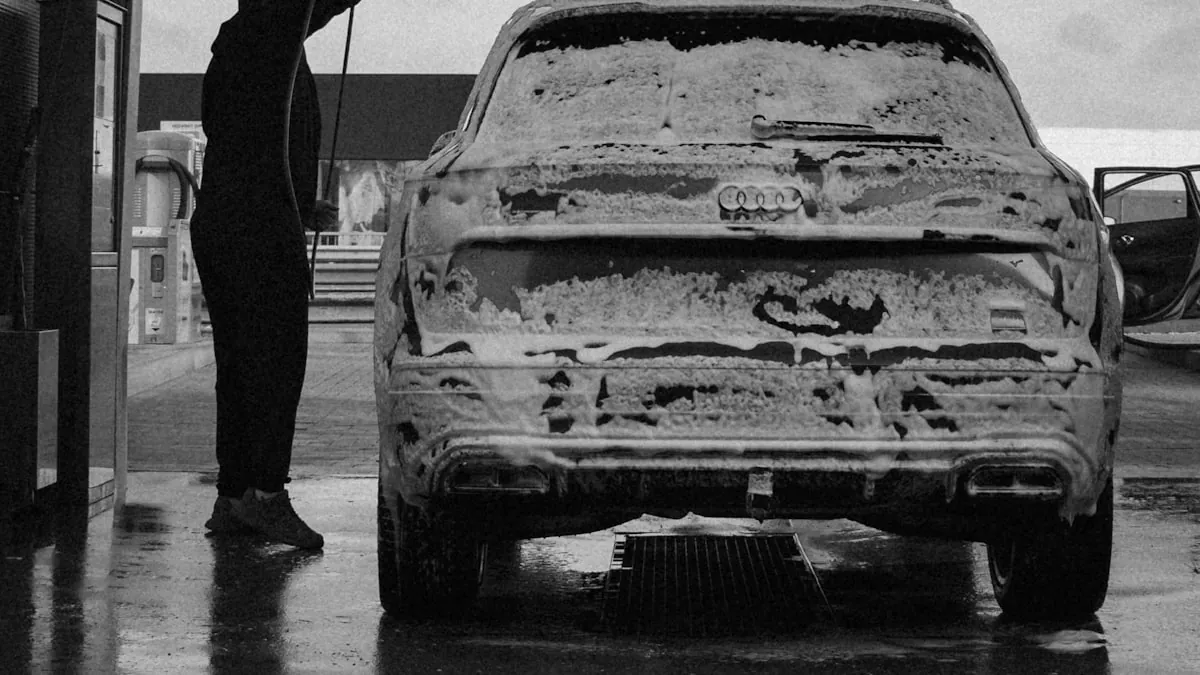
A professional decontamination follows a structured sequence that maximizes contamination removal while minimizing the risk of inflicting new damage. We begin with a thorough pre-rinse and foam wash using a pH-neutral shampoo to remove all loose surface dirt, because performing chemical decon on a dirty vehicle wastes product and risks grinding loose particles into the paint during the process. After the wash, we apply iron remover panel by panel, working systematically from the roof down and rinsing each section before moving to the next. The tar removal step follows the same systematic approach, targeting visible tar spots and treating the lower third of the vehicle where road tar concentrates most heavily. Finally, clay bar work proceeds panel by panel with constant lubrication, and we frequently check the clay surface for embedded debris, folding to a clean section whenever contamination is visible to prevent dragging captured particles across the paint.
How to Know Your Paint Needs Decontamination
Several indicators tell you that your vehicle needs decontamination beyond what you can see with the naked eye. The plastic bag test is the simplest diagnostic: place your hand inside a thin sandwich bag and run it lightly across washed paint, and the bag amplifies the texture feedback, making contamination that your bare fingers might miss immediately obvious as rough, gritty texture. Visible orange or brown speckles on light-colored paint, particularly on lower panels and behind wheel arches, indicate iron fallout that is actively corroding on the surface. If your vehicle has been parked near construction, railroad tracks, industrial facilities, or airports for extended periods, assume contamination is present even if you cannot see or feel it. In the Houston area, with its massive petrochemical corridor, shipping traffic, and constant construction, most vehicles accumulate meaningful contamination within 60 to 90 days regardless of where they are parked.
DIY vs Professional Decontamination
While basic decontamination is within reach of a careful car enthusiast, several factors make professional treatment the better choice for most situations. The products used in professional decontamination are commercial-grade formulations that are more effective and more consistent than consumer retail versions, and a professional understands the dwell times and safety margins for each product on different paint types and colors. The risk of marring during clay bar work is real and increases significantly with inexperience, as improper pressure, insufficient lubrication, or a dropped clay bar that picks up ground debris can create scratches that require paint correction to remove. If you are planning to have a ceramic coating or PPF installed, the decontamination should absolutely be performed by the same shop handling the installation, as they can assess the surface condition in real-time and ensure it meets the exact standard required for proper product adhesion.
Decontamination as the Foundation of Protection
At EuroLuxe Detailing, we consider decontamination the foundation upon which every other service builds. Whether a client is coming in for a simple sealant application, a multi-stage paint correction, a full ceramic coating installation, or a PPF wrap, the surface preparation starts with thorough chemical and mechanical decontamination that leaves the paint glass-smooth and chemically clean. This attention to preparation is what separates professional results from shortcuts, and it is the reason our coatings and films consistently perform at or beyond their expected lifespan. If you want your vehicle’s paint properly decontaminated and protected by a team that takes surface preparation as seriously as the final product, get a quote from EuroLuxe Detailing and see the difference that proper process makes.