Soft vs. hard clear coat: how it changes paint correction
Every paint correction job starts with the same goal — remove defects from the clear coat without cutting through it. But the strategy that gets you there changes considerably depending on one variable most car owners never think about: how hard or soft the clear coat actually is. That single property dictates which compounds work, how aggressively a pad can be used, how many passes are safe, and ultimately how well the paint corrects. Getting it wrong in either direction costs you gloss or, worse, clear coat thickness you cannot get back.
Manufacturers never publish a hardness spec on a window sticker, and there is no universal standard the industry has agreed on. What exists instead is a broad pattern that experienced installers learn through repetition: German and Japanese brands tend to run harder clear coats, American domestics and some Korean brands tend to run softer, and certain European marques — particularly Italian ones — can surprise you in both directions depending on the model year. These are tendencies, not rules, which is why paint thickness measurements and test spots are standard practice before any full correction begins.
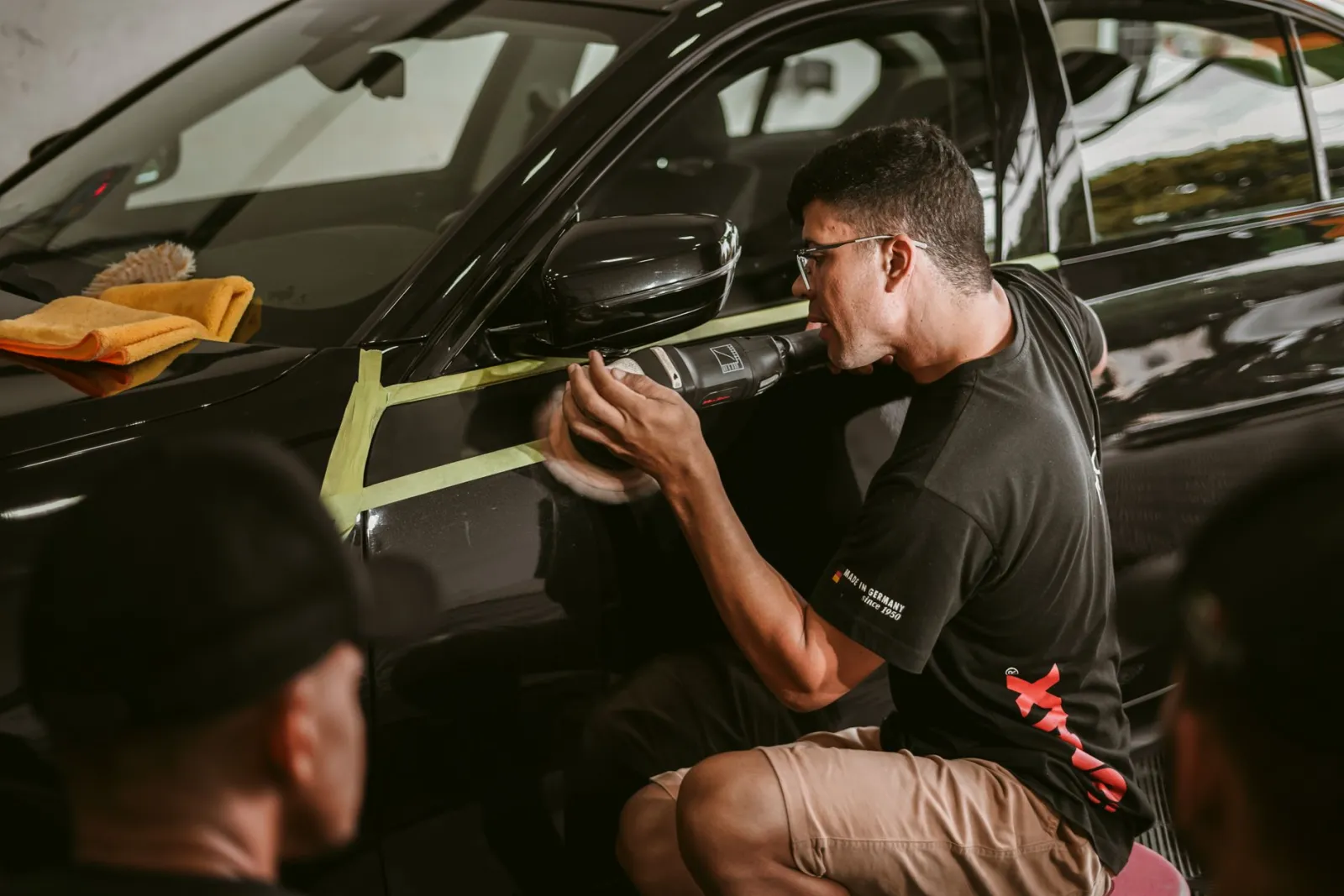
Understanding why hardness matters so much starts with understanding what polishing actually does. A compound or polish works by using abrasive particles to level the surface, cutting down the peaks of scratches and swirl marks until the surrounding clear coat meets them. A harder clear coat resists that cutting action; a softer one yields to it quickly. Neither is automatically better — they just require different approaches to achieve the same outcome.
How soft clear coats behave under a machine
Soft clear coats correct quickly. That sounds like an advantage, and in some ways it is — you can achieve high defect removal with a less aggressive compound, which means less heat and less risk of burning through thin areas. The problem is that soft clear coats also load up pads fast, generate more residue, and are far more sensitive to technique errors. Too much speed on the polisher, too much pressure, or too many overlapping passes and you will introduce new marring or, in a worst case, strike through the clear at an edge or body line where the paint is thinnest.
Vehicles with soft clear coats — certain Volkswagen models from the mid-2000s, some older Toyotas, several Chrysler products — can look spectacular after correction because the surface responds so readily. But that same softness means they scratch again easily in daily use, which is a strong argument for following paint correction with a durable ceramic or film layer to protect the work.
Pad selection matters just as much as compound choice on soft paint. A softer foam pad combined with a finishing polish will often accomplish what a medium pad and compound would do on harder paint. The goal is to use the minimum aggressiveness needed to achieve the target defect removal level. Over-cutting a soft clear coat takes seconds and cannot be undone without removing more material.
How hard clear coats respond to correction
Hard clear coats do not give up their defects easily. Swirl marks that look deep on a German sports sedan may require two cutting stages — a heavy compound pass followed by a finishing polish — to fully remove them, whereas the same apparent severity on softer paint might come out in a single finishing step. The upside is that hard clear coat forgives more mistakes in the other direction; you can make more passes without threatening the film thickness, and the surface holds its correction well once achieved.
The challenge is heat management and pad degradation. Hard paint requires firmer compounds and more aggressive pads, both of which generate more friction. Working in a climate-controlled environment matters here — high ambient heat accelerates compound breakdown and can cause the polish to dry on the surface before it finishes working, leaving residue that requires extra cleanup and occasionally light marring of its own.
BMW, Porsche, and Mercedes-AMG vehicles are routinely cited as having harder than average clear coats, and anyone who has corrected one will tell you that the first test spot often takes longer than expected. That is not a problem if you factor it into the job timeline. It becomes a problem if you assume the car will behave like the last one you worked on.
Why test spots are not optional
A test spot is a small area — usually six inches square — where the installer works through the full intended correction sequence before committing to the whole vehicle. The purpose is not just to verify the process works; it is to calibrate how the paint responds under that specific combination of machine, pad, compound, and ambient conditions. On an unfamiliar vehicle or a repainted panel, a test spot is the only reliable way to know whether you are dealing with hard or soft clear coat before you have touched the entire hood.
Paint thickness gauges add another layer of information. Measuring at multiple points across a panel reveals not just the overall film thickness but whether a previous correction or a past repaint has already consumed some of the available material. A panel that reads 80 microns of clear is not correctable the same way as one that reads 140. Those measurements change what level of correction is appropriate and whether the customer’s expectations can realistically be met.
This calibration process is where most shortcuts show up. A shop that skips the test spot and goes straight to a heavy compound on an unknown vehicle is guessing. Sometimes the guess is right. Sometimes it removes too much on the first pass and the installer is left managing the outcome rather than controlling it.
Matching protection to the corrected surface
Once correction is complete, what goes over the paint matters for how long the work lasts. A soft clear coat that has been corrected to a high level will begin picking up swirl marks again within weeks of unprotected washing. A hard clear coat holds up better in daily use but still benefits significantly from a protective layer.
Ceramic coating is the most practical follow-on for corrected paint. Applied correctly to a properly decontaminated and corrected surface, it fills in micro-texture, adds measurable hardness to the outermost layer, and makes subsequent washing dramatically safer. On soft clear coat vehicles specifically, adding a quality ceramic after correction is not an upsell — it is the difference between work that looks good for six months and work that holds for several years.
For vehicles where rock chip and abrasion protection is the primary concern on top of correction, a paint protection film installation over the corrected surface addresses threats that ceramic alone cannot. The paint underneath needs to be in good condition before film goes on; film traps what is there and does not improve it.
What this means for your vehicle
If you are scheduling paint correction and want to understand why the process cannot be quoted purely by panel count or vehicle size, this is a significant part of the answer. A two-stage correction on a hard-clear-coat BMW takes more time and more product than the same apparent defect level on a softer-paint domestic sedan. The results should look comparable when finished, but the path there is different.
Owners in the North Houston area — The Woodlands, Conroe, Cypress, Spring, Magnolia, Humble — driving a mix of European, domestic, and Asian vehicles will often find that their cars behave differently from what a friend described with a different make. That variation is real and is worth discussing before work begins. If you have questions about what your specific vehicle needs before committing to a service, call EuroLuxe at (936) 292-6056 and walk through the details with someone who has worked on the paint type you are dealing with.
Clear coat hardness is one of those technical details that rarely comes up in a conversation about detailing until something goes wrong. Understanding it in advance gives you better tools to evaluate what a shop is telling you, ask the right questions, and set realistic expectations for the finished result.